

What is the influence of the ball diameter on the performance of a ball screw guide rail?
As a supplier of ball screw guide rails, I've witnessed firsthand the critical role that ball diameter plays in the performance of these essential components. Ball screw guide rails are widely used in various industries, including manufacturing, automation, and robotics, to provide precise linear motion. The ball diameter is one of the key factors that can significantly affect the performance, efficiency, and durability of the ball screw guide rail system.
1. Load - carrying capacity
The load - carrying capacity of a ball screw guide rail is directly related to the ball diameter. Larger balls can distribute the load over a larger contact area between the ball and the raceway of the guide rail. According to the Hertzian contact theory, the contact stress between the ball and the raceway is inversely proportional to the square root of the ball diameter under a given load. So, when the ball diameter increases, the contact stress decreases, allowing the guide rail to withstand higher loads without excessive deformation or wear.
For example, in heavy - duty machining applications where large cutting forces are involved, ball screw guide rails with larger ball diameters are often preferred. These larger - ball guide rails can handle the substantial loads generated during the machining process, ensuring the stability and precision of the machine tool. On the other hand, in light - duty applications such as small - scale 3D printers or laboratory equipment, smaller ball diameters may be sufficient as the loads are relatively low, and smaller balls can also contribute to a more compact design.
2. Precision and accuracy
Precision and accuracy are of utmost importance in applications that require high - level positioning. The ball diameter can have a significant impact on these aspects. Smaller balls can provide better contact and tracking with the guide rail surface, which is beneficial for achieving high - precision motion. When the balls are smaller, they can follow the fine - scale irregularities of the raceway more closely, resulting in smoother and more accurate linear motion.
However, maintaining the consistency of small - ball diameters is more challenging during the manufacturing process. Even a slight variation in the diameter of small balls can cause noticeable differences in the motion accuracy. Larger balls, while generally having lower sensitivity to minor manufacturing variations, may not be able to achieve the same level of fine - motion control as smaller balls. Therefore, in applications where extremely high positioning accuracy is required, careful selection of ball diameter, along with strict quality control of the ball manufacturing process, is necessary.
3. Friction and efficiency
The ball diameter also affects the friction and efficiency of the ball screw guide rail system. Friction in the guide rail is mainly composed of rolling friction and sliding friction. When the ball diameter is larger, the rolling friction coefficient may increase slightly because the contact area between the ball and the raceway is larger, and there is more resistance during the rolling process.
On the other hand, larger balls can reduce the number of balls required in the guide rail system for a given length. With fewer balls, there are fewer contact points, which can potentially reduce the internal sliding friction caused by ball - to - ball interactions. In contrast, smaller balls have a lower rolling friction coefficient due to their smaller contact area, but the large number of balls in the system may increase the sliding friction among the balls.
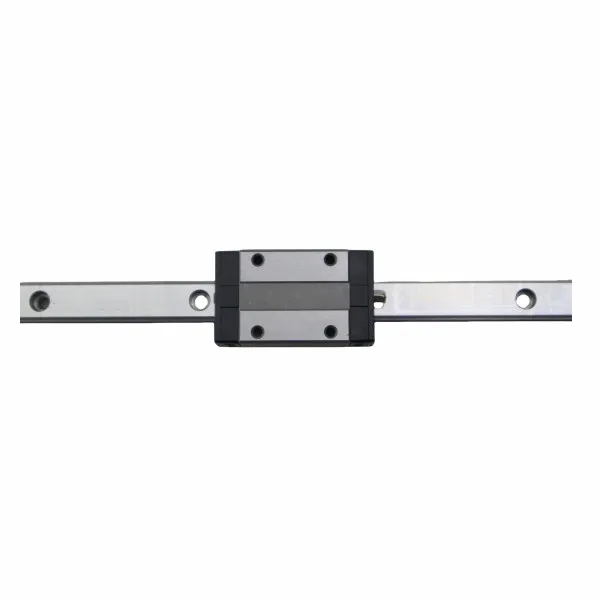
In high - speed applications, minimizing friction is crucial for improving efficiency and reducing heat generation. Therefore, a balance needs to be struck between ball diameter and friction to ensure optimal performance. If you want to learn more about the overall guide rail system related to these concepts, you can visit our Linear Guide Rail System page.

4. Life and durability
The life and durability of a ball screw guide rail are closely related to the ball diameter. As mentioned earlier, larger balls can withstand higher loads and lower contact stress, which generally leads to a longer service life. The wear rate of the balls and the raceway is reduced when the contact stress is lower.
In addition, larger balls are less likely to be damaged by contaminants or debris in the working environment. Smaller balls, however, are more vulnerable to damage from small particles, which can cause premature wear and failure of the guide rail system. In harsh industrial environments where there is a high risk of contamination, ball screw guide rails with larger ball diameters may be a more reliable choice. For applications where long - term durability is required, you can also consider our Linear Guide Rail 1500mm, which is designed to meet high - performance and long - life requirements.
5. Speed capabilities
The ball diameter can influence the speed capabilities of a ball screw guide rail. Smaller balls have a lower inertia, which means they can be accelerated and decelerated more quickly. This makes them suitable for high - speed applications where rapid changes in motion are required. For example, in some pick - and - place robots, small - ball guide rails can enable the robot to move at high speeds and perform tasks efficiently.
However, as the speed increases, the centrifugal force acting on the balls also increases. Larger balls are more resistant to the effects of centrifugal force due to their larger mass. In very high - speed applications, if the ball diameter is too small, the balls may be forced out of their normal path, leading to instability and reduced performance. Therefore, when designing a high - speed ball screw guide rail system, the ball diameter needs to be carefully selected based on the required speed range. If you are interested in high - speed guide rail applications, our Linear Guide Motor may be a good option to explore.
Conclusion
In conclusion, the ball diameter has a profound influence on the performance of a ball screw guide rail in multiple aspects, including load - carrying capacity, precision, friction, life, and speed capabilities. As a ball screw guide rail supplier, we understand the importance of selecting the appropriate ball diameter for different applications. We offer a wide range of ball screw guide rails with various ball diameters to meet the diverse needs of our customers.
Whether you are working on a heavy - duty industrial project, a high - precision automation system, or a high - speed robotics application, we can provide you with the right solution. If you have any inquiries about our ball screw guide rails or need assistance in selecting the most suitable product for your application, please feel free to contact us for procurement discussions. We are committed to providing you with high - quality products and professional technical support to help you achieve your project goals.
References
- Harris, T. A., & Kotzalas, M. N. (2007). Rolling Bearing Analysis. John Wiley & Sons.
- Stachowiak, G. W., & Batchelor, A. W. (2005). Engineering Tribology. Elsevier.