

Hey there! As a supplier of Ball Screw Guide Rails, I often get asked about the differences between ball screw guide rails and roller screw guide rails. So, I thought I'd break it down for you in this blog post.
Basic Structure and Working Principle
Let's start with the basics. A ball screw guide rail, like the ones we offer at Ball Screw Guide Rail, uses balls as the rolling elements. These balls are placed between the screw shaft and the nut. When the screw rotates, the balls roll along the raceways, converting rotational motion into linear motion. It's a pretty simple yet effective mechanism.
On the other hand, a roller screw guide rail uses rollers instead of balls. The rollers have a larger contact area with the screw shaft and the nut compared to balls. This allows them to handle higher loads and transmit more torque. The working principle is similar to that of a ball screw guide rail, but the use of rollers gives it some unique characteristics.
Load Capacity
One of the most significant differences between the two is their load capacity. Roller screw guide rails generally have a much higher load capacity than ball screw guide rails. The larger contact area of the rollers distributes the load more evenly, allowing them to handle heavier loads without excessive wear or deformation.
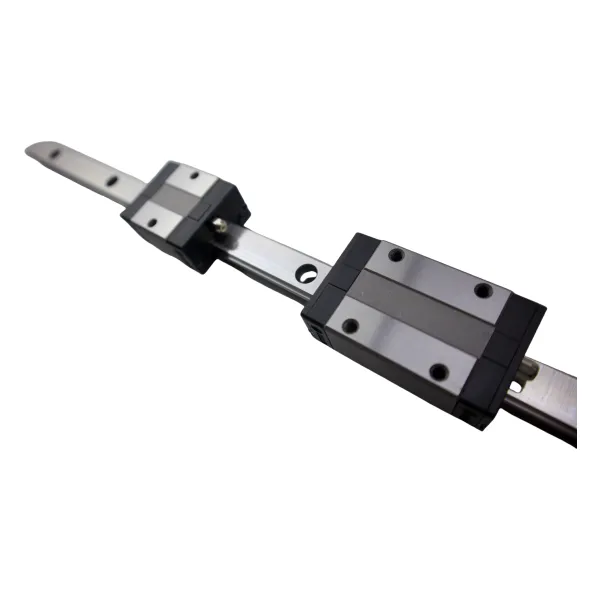

For example, in applications where you need to move large and heavy objects, like in industrial machinery or heavy equipment, a roller screw guide rail might be the better choice. However, if your application has relatively light loads, a ball screw guide rail can do the job just fine and is often more cost - effective.
Precision
When it comes to precision, ball screw guide rails are usually the winners. The small size of the balls allows for smooth and precise movement. They can achieve high levels of positioning accuracy, which is crucial in applications such as CNC machines, robotics, and semiconductor manufacturing.
Roller screw guide rails, while still quite precise, may not offer the same level of accuracy as ball screw guide rails. The larger size of the rollers can introduce a bit more play and less precise movement, especially at high speeds. But in applications where high load capacity is more important than extreme precision, this might not be a deal - breaker.
Speed
Ball screw guide rails are generally faster than roller screw guide rails. The small balls can roll at higher speeds with less friction compared to the larger rollers. This makes ball screw guide rails ideal for applications that require high - speed linear motion, such as pick - and - place robots or high - speed packaging machines.
Roller screw guide rails, due to the larger size and mass of the rollers, have a higher inertia. This means they take longer to accelerate and decelerate, limiting their maximum speed. However, they are better suited for applications where high torque and load capacity are needed, even at lower speeds.
Efficiency
In terms of efficiency, ball screw guide rails are more efficient than roller screw guide rails. The rolling friction of the balls is lower than that of the rollers, which means less energy is wasted as heat. This can result in lower operating costs over the long term, especially in applications where the guide rail is in constant use.
Roller screw guide rails, while less efficient, make up for it with their high load - carrying capacity. In applications where the cost of energy is not a major concern and high loads need to be handled, the trade - off in efficiency might be acceptable.
Life Span
The life span of a guide rail depends on many factors, including the load, speed, and operating environment. Generally, roller screw guide rails have a longer life span than ball screw guide rails when operating under heavy loads. The larger contact area of the rollers distributes the load more evenly, reducing the stress on individual components and minimizing wear.
However, in light - load and high - speed applications, ball screw guide rails can also have a long life span. With proper lubrication and maintenance, they can operate reliably for many years.
Cost
Cost is always an important factor when choosing a guide rail. Ball screw guide rails are typically less expensive than roller screw guide rails. They are easier to manufacture, and the materials used are generally less costly. This makes them a popular choice for applications with budget constraints.
Roller screw guide rails, due to their more complex design and higher - performance capabilities, are more expensive. But if your application requires high load capacity, high torque, or long - term reliability under heavy loads, the extra cost might be worth it.
Applications
Ball screw guide rails are widely used in a variety of applications. They are commonly found in Linear Ball Bearing Slides and Linear Guide Rail System. Some of the typical applications include:
- CNC Machines: For precise positioning of the cutting tools.
- Robotics: To control the movement of robot arms.
- 3D Printers: For accurate movement of the print head.
Roller screw guide rails are more suitable for heavy - duty applications, such as:
- Industrial Presses: To handle high - force operations.
- Aerospace Equipment: Where high reliability and load capacity are required.
- Large - scale Manufacturing Machinery: For moving heavy components.
Conclusion
In conclusion, both ball screw guide rails and roller screw guide rails have their own unique advantages and disadvantages. The choice between the two depends on your specific application requirements, such as load capacity, precision, speed, efficiency, and cost.
If you're looking for a cost - effective solution with high precision and speed for light - load applications, a ball screw guide rail is a great choice. On the other hand, if you need to handle heavy loads, high torque, and can tolerate a bit less precision and speed, a roller screw guide rail might be more suitable.
As a supplier of Ball Screw Guide Rails, we're here to help you make the right choice for your application. If you have any questions or need more information, feel free to reach out to us. We can provide you with detailed product specifications, technical support, and even samples for testing. Let's start a conversation and find the perfect guide rail solution for you!
References
- "Mechanical Design Handbook"
- "Linear Motion Technology: Principles and Applications"