

The RGW45 linear guides are essential components in the field of precision machinery, offering high - precision linear motion solutions for a wide range of industrial applications. As a reliable supplier of RGW45 linear guides, I am well - versed in their dimensions and technical specifications, which I will elaborate on in this blog.
Overall Dimensions
The overall dimensions of the RGW45 linear guides are carefully designed to meet the requirements of various installation spaces and load - bearing needs. The length of the guide rail can be customized according to the specific application scenarios. Commonly, the lengths range from a few hundred millimeters to several meters. For example, in some small - scale automation equipment, a shorter guide rail length of around 300 - 500 mm may be sufficient, while in large - scale machine tools or heavy - duty manufacturing equipment, guide rails with lengths of 2 - 3 meters or even longer might be required.
The width of the RGW45 guide rail is approximately 45 mm, which gives it the name. This width provides a stable base for the carriage to move along the rail. A proper width is crucial as it affects the load - carrying capacity and the stability of the linear motion. A wider rail can generally support larger loads and resist lateral forces better, while a narrower rail may be more suitable for applications with limited space.
The height of the guide rail also varies depending on the specific model and design. Usually, it is designed to ensure a proper center of gravity for the carriage and to maintain a smooth and stable movement. The height is typically optimized to balance the load - carrying capacity and the overall compactness of the linear guide system.
Carriage Dimensions
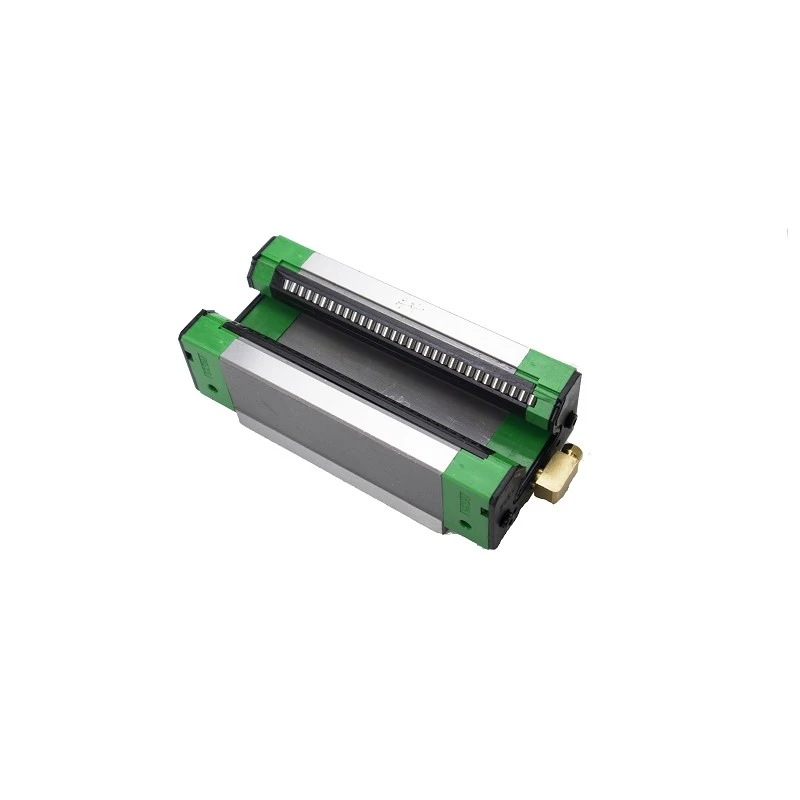
The carriage of the RGW45 linear guides is another important part, and its dimensions are closely related to the functionality and performance of the whole system. The length of the carriage is designed to fit the guide rail and provide sufficient contact area for smooth movement. It is usually shorter than the guide rail length but long enough to house the rolling elements and the necessary components for guiding and load - transfer.
The width of the carriage is slightly wider than the guide rail to ensure proper alignment and smooth movement. This extra width allows for the installation of seals and other protective components to prevent dust and debris from entering the guide system, which can significantly extend the service life of the linear guides.
The height of the carriage is designed to accommodate the rolling elements, such as rollers or balls, and the pre - loading mechanism. A proper height ensures that the rolling elements can roll freely and transfer the loads evenly to the guide rail. The height also affects the overall height of the linear guide system, which is an important consideration in applications with height restrictions.
Installation Dimensions
Installation dimensions are of great importance when integrating the RGW45 linear guides into a machine or equipment. The mounting holes on the guide rail and the carriage are precisely positioned to ensure accurate installation. The pitch of the mounting holes on the guide rail is designed to match the standard mounting patterns of common machine frames and components, which makes the installation process more convenient and efficient.
The diameter of the mounting holes is also carefully selected to ensure a secure connection. It should be large enough to accommodate the appropriate bolts or screws, while not being too large to cause instability. The depth of the mounting holes is designed to ensure a sufficient thread engagement for a reliable connection.
Comparison with Other Linear Guides
When comparing the RGW45 linear guides with other similar products, such as RGH35 Linear Guides, RGW25 Linear Guides, and RGW55 Linear Guides, the differences in dimensions play a significant role.
The RGH35 linear guides have a smaller width of 35 mm compared to the 45 mm of the RGW45. This makes the RGH35 more suitable for applications with limited space but may have a relatively lower load - carrying capacity. The RGW25 linear guides, with a width of 25 mm, are even more compact and are often used in lightweight and small - scale automation equipment.
On the other hand, the RGW55 linear guides have a wider width of 55 mm. They are designed for heavy - duty applications that require a higher load - carrying capacity. The larger dimensions of the RGW55 allow it to support larger loads and resist more significant lateral forces, but they also require more installation space.
Technical Specifications Related to Dimensions
The dimensions of the RGW45 linear guides are also closely related to other technical specifications. For example, the load - carrying capacity is directly affected by the dimensions of the guide rail and the carriage. A larger cross - sectional area of the guide rail and a more robust carriage design can generally support higher loads.
The accuracy of the linear motion is also influenced by the dimensions. Precise manufacturing of the guide rail and the carriage dimensions ensures a high level of straightness and parallelism, which is essential for applications that require high - precision positioning, such as in semiconductor manufacturing equipment and optical inspection systems.
The speed of the linear motion is related to the dimensions as well. A well - designed dimension can reduce the friction and resistance during the movement, allowing for higher - speed operation. The rolling elements inside the carriage, along with the proper dimensions of the guide rail and the carriage, work together to achieve a smooth and high - speed linear motion.
Applications Based on Dimensions
The unique dimensions of the RGW45 linear guides make them suitable for a wide range of applications. In the field of machine tools, such as milling machines, lathes, and grinding machines, the RGW45 linear guides can provide high - precision linear motion for the tool heads and worktables. The proper dimensions ensure accurate positioning and smooth movement, which are crucial for achieving high - quality machining results.
In the automation industry, the RGW45 linear guides are widely used in conveyor systems, pick - and - place robots, and other automated equipment. Their dimensions allow for easy integration into different mechanical structures, and the high - precision motion they provide helps to improve the efficiency and reliability of the automation processes.

In the field of medical equipment, such as CT scanners and X - ray machines, the RGW45 linear guides are used to ensure the accurate movement of the scanning components. The compact yet robust dimensions of the linear guides are suitable for the strict space requirements and the high - precision needs of medical applications.
Conclusion
In conclusion, the dimensions of the RGW45 linear guides are carefully designed and optimized to meet the diverse needs of different industries and applications. As a supplier of RGW45 linear guides, I understand the importance of these dimensions in ensuring the high - quality performance of the linear guide systems. Whether you are looking for a high - precision linear motion solution for a small - scale automation project or a heavy - duty application in a large - scale manufacturing plant, the RGW45 linear guides with their well - defined dimensions can be an excellent choice.
If you are interested in our RGW45 linear guides or have any questions regarding their dimensions, technical specifications, or applications, please feel free to contact us for further discussion and procurement negotiation. We are committed to providing you with the best products and services to meet your specific requirements.
References
- Linear Guide System Design Manual, Industry Standard Publication
- Technical Documents of RGW45 Linear Guides, Manufacturer's Manuals